
English
Coat of arms of Szegvár
A coat of arms is a graphic application that identifies a settlement in some way, and in modern times it is often used as an emblem of a locality. Historically, coats of arms were developed in the Age of Chivalry, when the symbols appearing on the shields of knights were used to identify them on the battlefield.
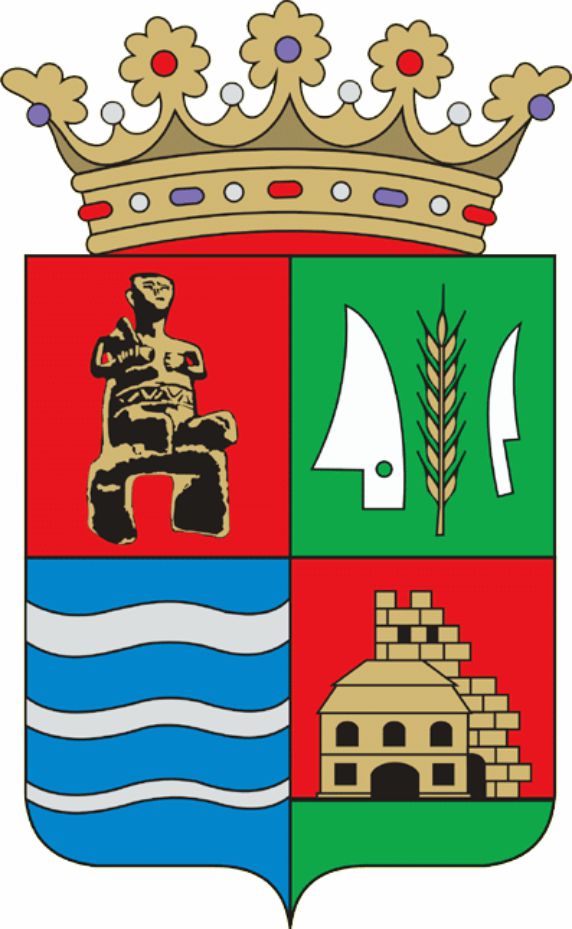
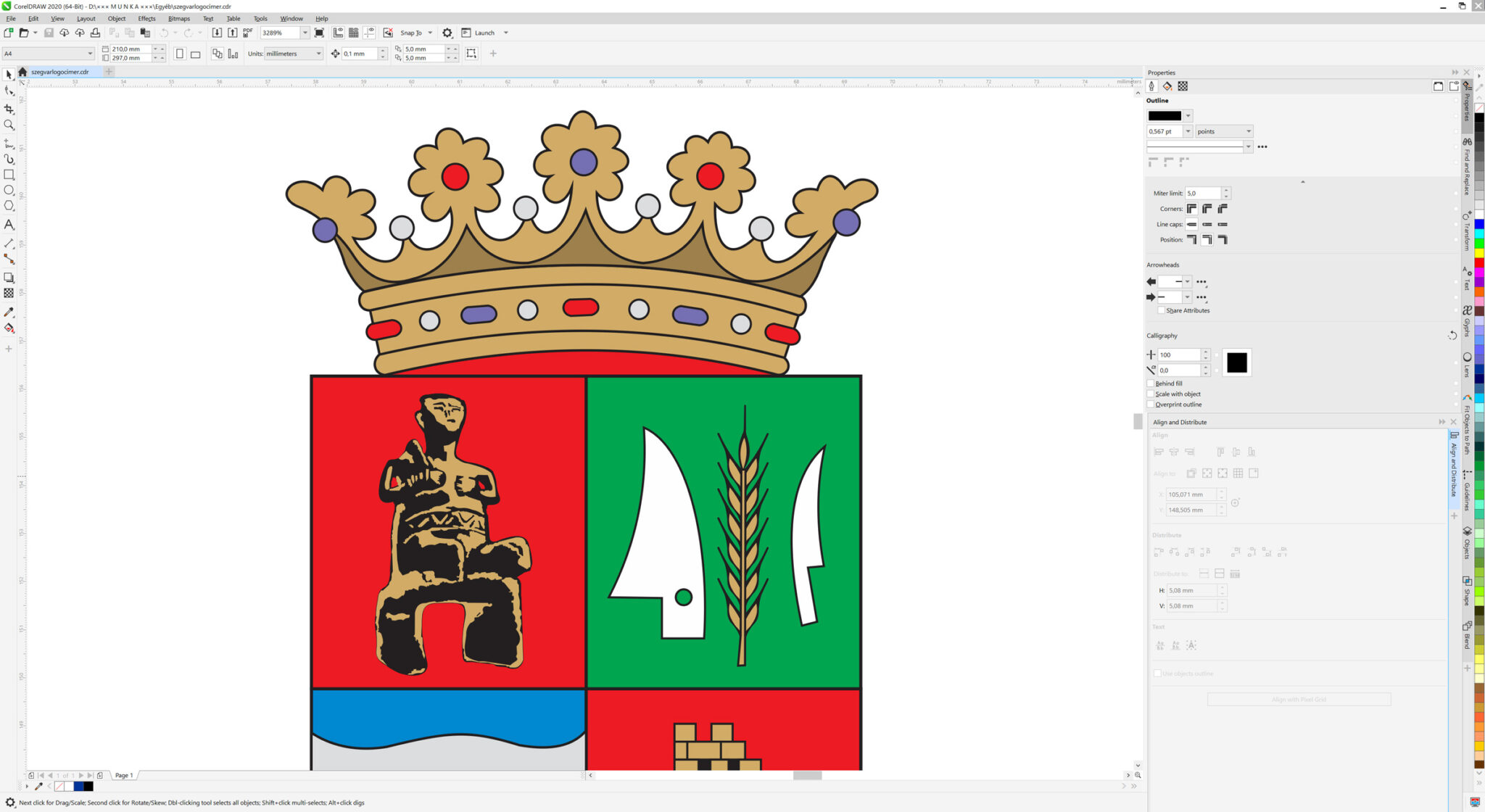
The new coat of arms of Szegvár is more than 20 years old. Under the “crown” it shows four symbols that refer to the past of Szegvár. In the upper left part, the symbol of the Sickle God, which means that this also significant European find was found in Szegvár, and that Szegvár is more than eight thousand years old. In the upper right part, the plowshare, wheat ears, and coulter mean that the population of Szegvár has always been engaged in agriculture and grain production. In the lower left part, the Tisza, Kurca, and Kórógy-ér symbolize that Szegvár is the village of waters. The county symbol is visible in the lower right part, which indicates that Szegvár was the seat of Csongrád County from 1776 to 1883.
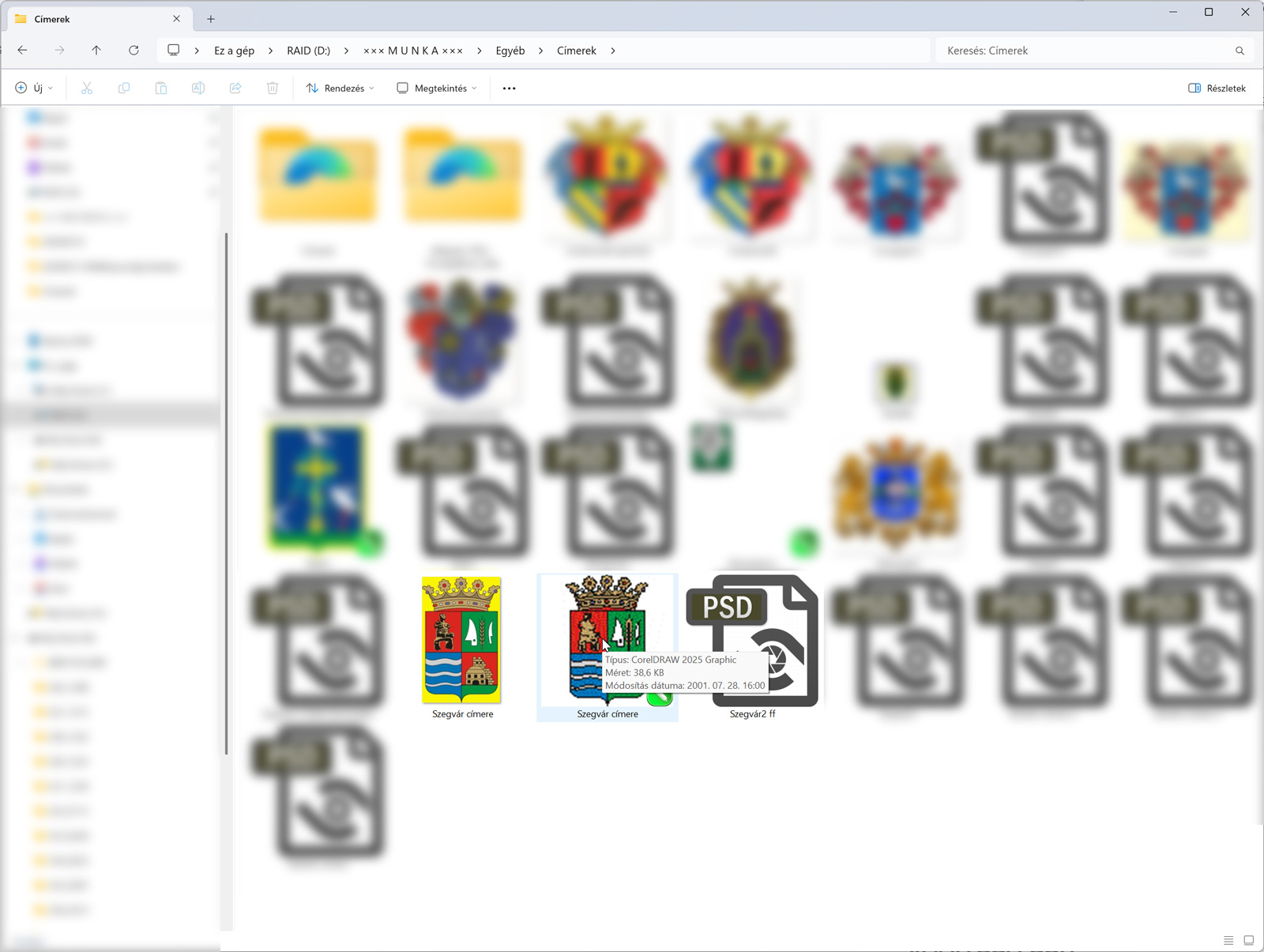
I drew the new coat of arms of Szegvár in vector graphics from July 26 to 28, 2001 (with three full days of work), on my computer, using the CorelDraw program. The word vector graphics means that the graphics do not consist of pixels / pixels, but are composed of geometric shapes (circles, squares, polygons, points, lines, curves, etc.) through mathematical formulas. Its advantage is that it can be enlarged without loss of quality, it does not become pixelated, like a photo.
As a local patriot, a person who wants to do something for the community, I created the coat of arms free of charge, without remuneration, and I offered it to Szegvár so that anyone can use it without any compensation, at any time, irrevocably free of charge. I consider the coat of arms „my own child”, the copyright belongs to me, my creation is officially registered with the Hungarian Intellectual Property Office.
Documents
- Semantic analysis (Hungarian Intellectual Property Office – Szellemi Tulajdon Nemzeti Hivatal)
- Certificate (Hungarian Intellectual Property Office – Szellemi Tulajdon Nemzeti Hivatal)
- Specimen (ASICE, Hungarian Intellectual Property Office – Szellemi Tulajdon Nemzeti Hivatal)
- Original vector graphic file (CDR – 28/07/2001.)
Hungarian
Szegvár címer
A címer egy olyan grafikai alkalmazás, amely valamilyen módon azonosít egy települést, a mai korban sokszor emblémának is használja egy helység. A címerek történelmileg a lovagi korban alakultak ki, amikor a lovagok pajzsán megjelenő jelképek segítették azonosítani őket a csatatéren.
Szegvár új címere már több mint 20 éves. A „korona” alatt négy jelkép jelenik meg, amely Szegvár múltjára utal. A bal felső részen a Sarlós Isten jelképe, amely azt jelenti, hogy Szegváron találták meg ezt az európai szinten is jelentős leletet, valamint azt, hogy Szegvár több mint nyolcezer éves. A jobb felső részen az ekevas, búzakalász, csoroszlya azt jelenti, hogy Szegvár lakossága mindenkor mezőgazdasággal, gabonatermesztéssel foglalkozott. A bal alsó részen a Tisza, a Kurca és a Kórógy-ér azt szimbolizálja, hogy Szegvár a vizek falva. A jobb alsó részen pedig a vármegyeház jelképe látható, ez arra utal, hogy Szegvár 1776-tól 1883-ig volt Csongrád vármegye székhelye.
Szegvár új címerét 2001. július 26-tól 28-ig (három teljes napi munkával) rajzoltam meg vektorgrafikusan, számítógépemen, a CorelDraw programmal. A vektorgrafikus szó azt jelenti, hogy a grafika nem pixelekből / képpontokból áll, hanem matematikai képleteken keresztül geometriai alakzatokból (körökből, négyszögekből, sokszögekből, pontokból, egyenesekből, görbékből, stb…) tevődik össze. Előnye, hogy minőségromlás nélkül nagyítható, nem pixelesedik, mint pl. egy fotó.
A címert mint helyi lokálpatrióta, a közösségért tenni akaró személy, ingyenesen, díjazás nélkül készítettem, s felajánlottam Szegvárnak, hogy azt bárki, bármilyen ellenszolgáltatás nélkül, bármikor, visszavonhatatlanul ingyen használhatja. A címert „saját gyermekemnek” tekintem, a szerzői jog engem illet, alkotásom hivatalosan be van jegyezve a Szellemi Tulajdon Nemzeti Hivatalnál.